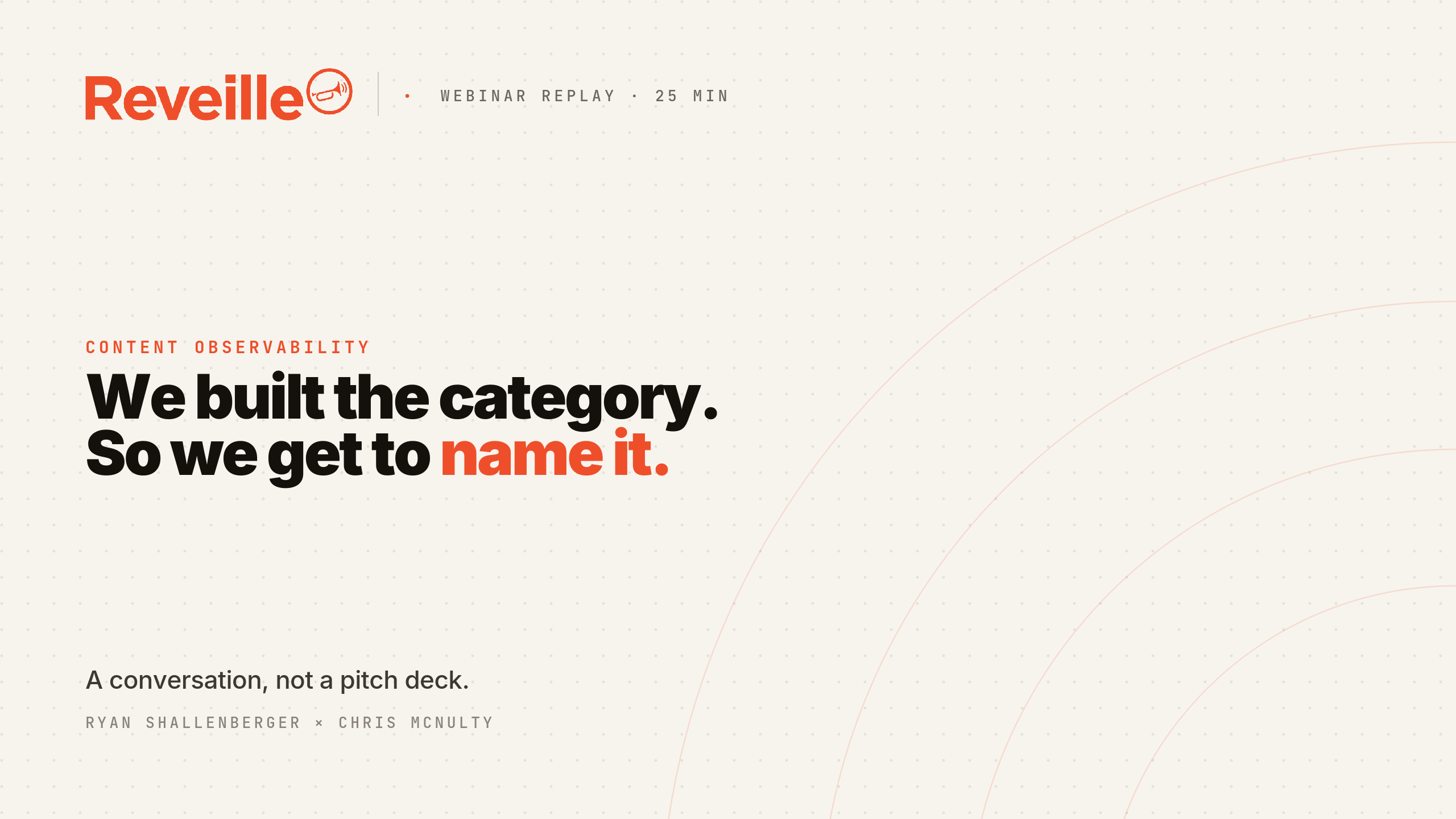

A recap of the Reveille fireside chat with Chris McNulty and Ryan Shallenberger, now available on demand.
Earlier this month, I sat down with our own Ryan Shallenberger for a fireside chat on content observability. We booked 30 minutes and could have easily gone for an hour.
Here’s what we covered.
Format
Fireside chat
With
Chris McNultyChief Product Officer
Ryan ShallenbergerDirector, Corporate & Partner Marketing
Replay
On demand30 min · recorded Sept 1, 2026
01
The most common monitoring tool in the enterprise is still a person
We opened with a poll: how do you usually find out that a content workflow has stalled? The top answer was “a user tells us.” A dashboard or alert firing came second.
Live poll
How do you usually find out that a content workflow has stalled?
- “A user tells us”
- A dashboard or alert firing
That matches what I hear in the field. The week before, at TechCon 365 here in the Seattle area, three separate people told me the same story about e-signature workflows. The process is up. The system is available. Somewhere along the way a user hits an authentication failure, because they didn’t log in properly, and the request sits for two weeks until somebody says “nobody ever got back to me on that signature.”
Every light was green the whole time. Users are a good backstop and a slow one, and two weeks is a long time to spend learning that the system was working fine.
02
IDP opened the front door wider. It did not put windows in the building
Ryan asked whether intelligent document processing, having made capture intelligent, also made it observable. It didn’t. Think about the theory of constraints. Automate the bottleneck where people handle documents by hand, and you will create new bottlenecks somewhere else in the system.
IDP means the front door for content is open wider, and if it’s a revolving door, it spins faster. That is a real win. But if the only thing you’re watching is the counter on the way in, you have no idea whether anything downstream of intake worked.
Downstream is more places than it used to be. Research we did while I was at Microsoft put the average organization at 50 to 70 line of business systems. Not all of them are content systems, and content is tangled up in most of them.
Blindfolded, I could walk down the sidewalk outside my house and get pretty far, because I’m not moving fast. I would not put on a blindfold and get into my car. The blindfold gets dangerous at 40 miles an hour.
03
Get six steps off the dance floor
When I was at Microsoft, my manager Spataro talked at a leadership retreat about the importance of “getting off the dance floor” – a business metaphor. It’s great to dance and great to give dance lessons, and you still don’t understand the room until you climb six steps above the floor and look down at who’s moving, who’s stuck, and who walked out.
That’s the argument for content observability, and it’s why it has to live above the platform instead of inside it.
When everything lived in one silo, you had a unitary system with synchronous communication throughout, and signals were easy to come by. Now there’s an asynchronous layer stacked on top: agent to agent traffic, retrieval over MCP servers, LLM performance that varies from run to run. All of it hungry for your content. Is it getting that content correctly? Some of it? None of it? And how would you know?
04
Where the classic observability vendors stop
Ryan brought up Splunk and Datadog, which plenty of our audience already runs. My answer was short: they don’t understand the document.
They’re excellent at CPU, network, and error rates, and that is foundational for any information system that flows well. Our vantage point is different. The content is what makes one claim in process different from the next one. The document is the unit that matters, along with how it gets processed, who accesses it, and whether authentication fails along the way.
05
87% said no
Second poll: if you turned Copilot or an agent loose on your content estate tomorrow, would you trust what it found? 87% said no.
Live poll
If you turned Copilot or an agent loose on your content estate tomorrow, would you trust what it found?
Nobody on that call is consciously running an insecure data estate. These are careful people who did the cloud migration, did the security review, and believe they’re following the right processes. The gap is visibility.
Retrieval today is a complicated dance between traditional lexical indexing and modern semantic indexing, plus security trimming, recency signals, and collaborative signals to work out relevance. If something times out, it times out. In an interactive prompt you might see a note that a connection failed. In a process running lights out, or in something more agentic, whatever the agent does behind the scenes is invisible to you. I said on the call that sunlight is a good disinfectant, and that’s most of what we do: show you what happened to your content.
06
One thing to do in the next 90 days
Ryan gave me two questions and told me to pick one. I picked this one.
Before you scale agents, get honest about what an agent is. Very few people can define it. Here’s a workflow all of us use several times a year: the out of office assistant. It runs on its own. You give it a window and a set of conditions and it acts without you. It’s useful, and it isn’t an agent, because it doesn’t navigate.
Ten years ago I watched organizations digitize their workflows by taking a form somebody used to fill out on paper and mail, and turning it into a form somebody fills out on screen and emails. Whole cloth. Nobody stopped to ask whether that was the right process to begin with. I’d rather not watch that movie again with agents in it.
Then pick a project that touches revenue. An agent that helps people choose t-shirts for the company picnic is safe, and it’s safe because nothing depends on it. Too many pilots means nobody can focus on any of them. Pick something that matters.
From the session: quick answers
How do teams usually find out that a content workflow has stalled?
Did intelligent document processing make capture observable?
Where do Splunk and Datadog stop?
What should you do before you scale agents?
If you want to see what content observability looks like, there’s a sandbox trial. One field, no credit card, nothing to install. To be clear about what that is, as I clarified live on the call: it’s a generic sandbox estate, not a look into yours.
How are you using content observability today? Please let us know, and we’ll be back with another fireside chat soon. Thanks.
Chris McNulty is Chief Product Officer at Reveille Software. He previously spent nearly ten years as Senior Director of Product Marketing for Microsoft 365, leading go-to-market for Copilot, Viva, Syntex, SharePoint, and Teams, and held CTO and GM roles at Synozur, Dell, and Quest Software. He serves on the boards of AIIM and the Seattle Tech Forum.