
The people who run OnBase every day know more about administering it than any vendor, including us.— The Reveille Perspective
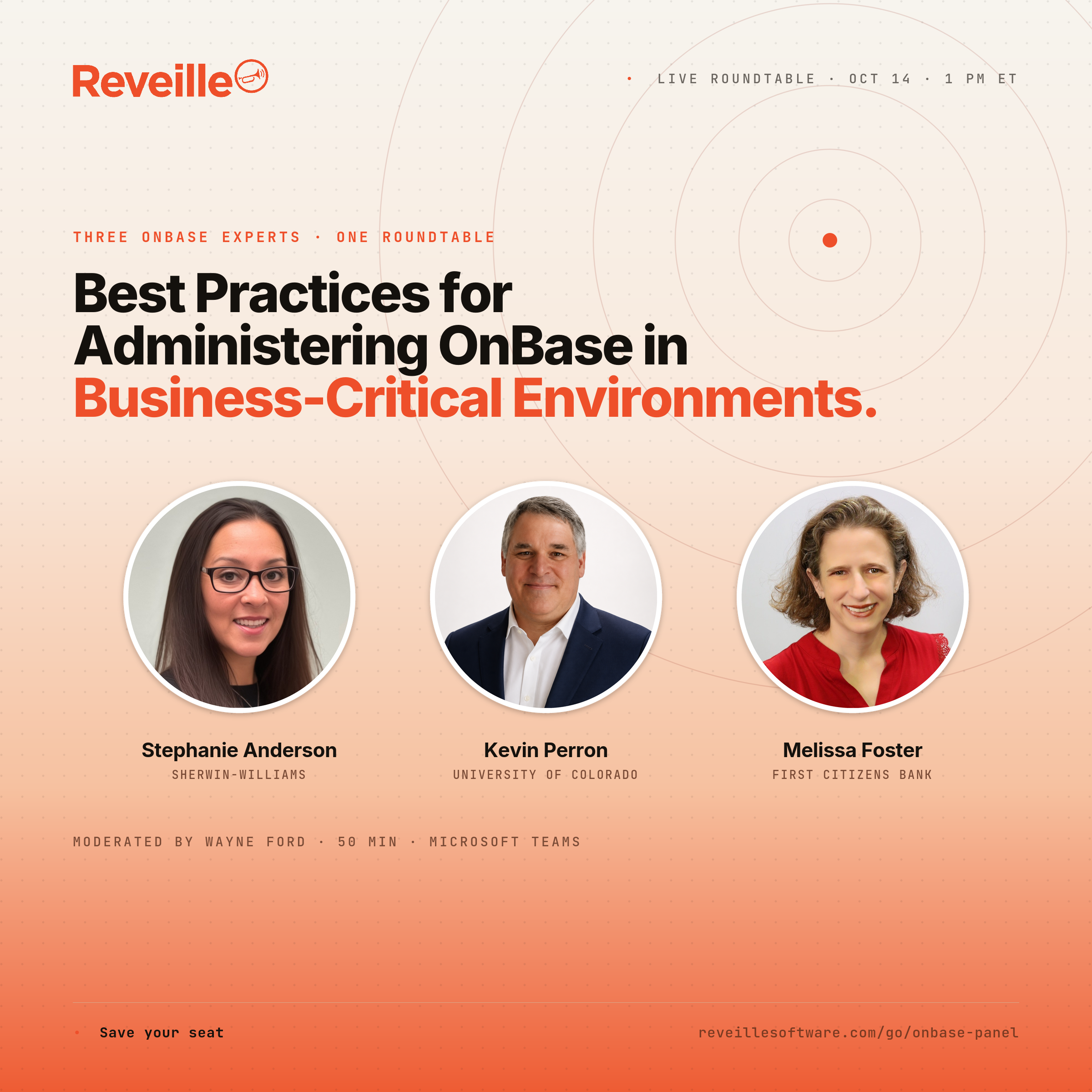
On October 14, three OnBase administrators are going to answer six questions in front of whoever shows up. Stephanie Anderson runs OnBase for a manufacturer. Kevin Perron runs it at the University of Colorado. Melissa Foster runs it at First Citizens Bank. Manufacturing, higher education, banking: three industries where a slow retrieval or a stuck Workflow queue is a business problem, not an IT one.
Reveille is hosting, and Wayne Ford is moderating, but the panelists aren’t there to talk about Reveille. They’re there to talk about what it takes to run OnBase when the business depends on it. We wrote the questions. This post explains why these six, what each one is really asking, and what a weak answer would sound like, so you can judge the answers for yourself.
The thread through all six is the same: OnBase administration best practices are different once the platform is business-critical, and the people who know the difference are the ones who lived through the change.
Core Tension
Every OnBase environment becomes business-critical eventually. Almost none are administered as if they already are.
Quick answers
What are OnBase administration best practices?
What makes an OnBase environment business-critical?
What causes OnBase configuration drift?
Which OnBase signals should administrators watch first?
01 — The Six
The questions, and what each one is really asking
What each one is really asking, and how to judge the answers.
1. What changes when OnBase becomes business-critical rather than simply important?
Most environments cross this line without a memo. One year OnBase holds records; the next year invoices, claims, or enrollment stop when it does. The platform is the same. The tolerance for a slow retrieval is not. This question forces the panel to describe what they actually changed: who gets paged, how change windows shrank, what “it’s working” now has to mean.
A weak answer sounds like: “we added more monitoring.” The real answer is about ownership and tolerance, and it usually involves an uncomfortable conversation with the business about what they’re relying on.
2. What stops configuration drift?
Drift is not one bad change. It’s a hundred reasonable ones: a Workflow rule edited at 4 PM during an incident, a timer adjusted for one department, a scan queue reassigned and never reviewed. Six months later production matches no document anyone can find. The panel will get specific about change control and the pre-production checklist, and about what they gave up to keep it.
A weak answer sounds like: “we document everything.” Everyone says that. The useful answer names the review that happens before a change reaches production, and who has the authority to say no.
3. Which monitoring signals show up before users notice?
The help desk is a lagging indicator. Queue depth, timer lag, retrieval latency, and capture backlog move first, sometimes by hours. This question is about which of those signals each administrator trusts, which alerts they’ve turned off, and how they keep the on-call person from ignoring the pager. (The full set of what Reveille checks on OnBase is published here; the panel’s job is to say which ones matter in practice.)
A weak answer sounds like: a list of everything you could monitor. The strong answer is short, ranked, and includes at least one alert they deliberately removed.
4. Which routine administration mistakes create the biggest downstream risk?
Not the dramatic ones. The routine ones: a keyword type added without an index plan, a Workflow queue nobody owns after a reorg, a service account password rotated without a dependency map. Each looks small in the ticket. Each has caused an outage somewhere. The panel will name the ones they’ve made or inherited.
A weak answer sounds like: generic advice about testing. The strong answer is a specific mistake, a specific consequence, and the practice that now prevents it.
5. How do you keep one view across Workflow, capture, integrations, and retrieval?
A business-critical process rarely lives in one OnBase component. A document is captured, indexed, routed, integrated, and retrieved, and each step has its own tooling and its own owner. When something is slow, the first question is which step. This question is about how each administrator sees the whole path, and what they still can’t see.
A weak answer sounds like: “we use the built-in tools.” Each tool shows its own component. The interesting answer is how they correlate across them, or admit they can’t.
6. If you only had 30 days, where would you start?
Thirty days is long enough to fix one thing properly and short enough to force a choice. Each administrator picks a different first move, and the reasoning behind the pick says more about administration priorities than any framework would.
A weak answer sounds like: a full roadmap. The strong answer is one priority and the reason it comes first.
Live roundtable · Wednesday, October 14 · 1 PM ET
Hear the answers from the people who run it.
Fifty minutes on Microsoft Teams. Forty of them are the six questions above; the last ten are yours.
Best Practices for Administering OnBase in Business-Critical Environments, with Stephanie Anderson, Kevin Perron, and Melissa Foster. Moderated by Wayne Ford.
02 — Why These Six
Why not “how do you patch” or “what’s your backup strategy”
The questions we didn’t ask, and the one we always do.
Patching, backups, and upgrade paths matter, and Hyland documents them well. They’re also the same answer in every organization. The six questions above are the ones where the answer depends on the business the environment serves, which is why a bank, a university, and a manufacturer are on the same panel. Where their answers agree, that’s a best practice. Where they differ, the reasons are worth hearing.
We also left out the product. Reveille sees OnBase from the outside: Reveille for OnBase observes Workflow queues, retrieval, capture, and integrations as one path, which is the view question five asks about. But the panelists weren’t asked to mention it and won’t be prompted to. The session is about administration, and the credibility comes from that.
There is a seventh question. We ask it at every roundtable, and it’s the one people remember: what about your OnBase environment keeps you up at night?
The Reveille Perspective
Platform SLA is not Workflow SLA. A healthy server and a stuck queue can exist at the same time, and only one of them shows up in the business.
03 — The Point
Why it’s worth fifty minutes
What an administrator gets out of the session.
In one version, an OnBase administrator spends fifty minutes on October 14 hearing three peers describe the review that catches drift, the alert they turned off, and the first thing they’d fix with thirty days. One of those answers changes something in their environment before the end of the quarter.
In the other, the same administrator finds out which signal they should have been watching at 4:10 on a Friday, from a director who wants to know why invoices stopped.
The difference isn’t the platform. It’s whether the environment was administered as business-critical before the business proved it was.