
The observability industry just spent $915 million proving AI agents need watching. Then it stopped one layer short of where they work.— The Reveille Perspective
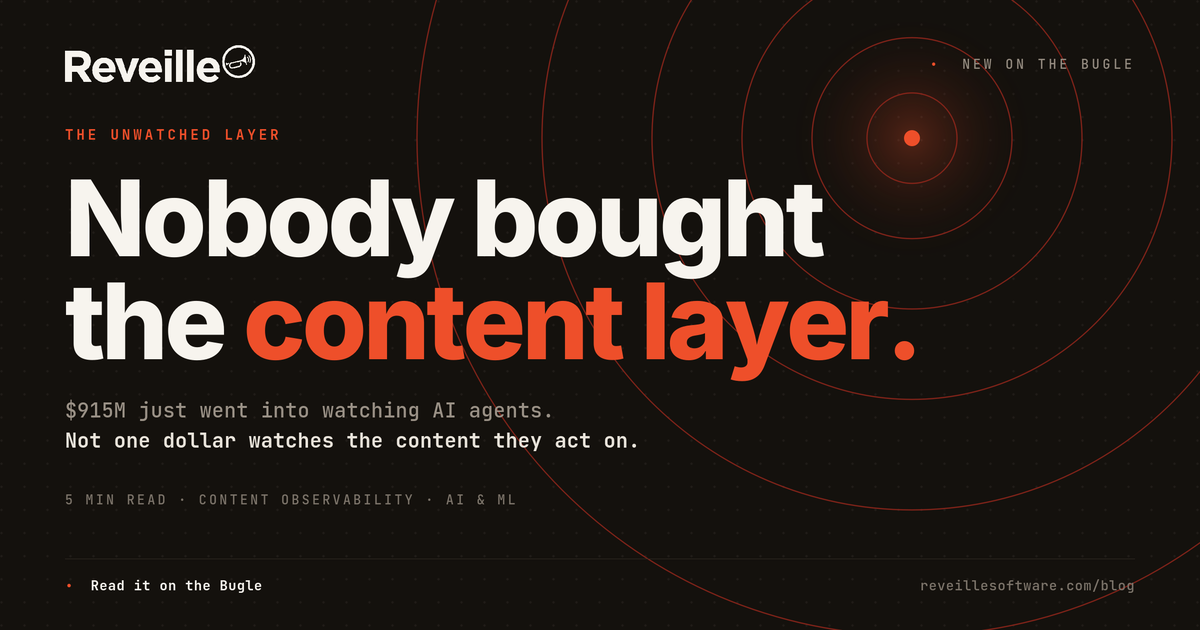
On August 13, Dynatrace signed a definitive agreement to acquire Arize AI — the company behind the Phoenix tracing platform and the OpenInference standard — for a reported $915 million. A week earlier, Datadog’s CEO told analysts about “an explosion in agent monitoring volume.” Splunk has themed its September .conf around agentic observability. In ten days, the market voted, with money: AI agents cannot be trusted unwatched.
The market is right. And every dollar of it stops at the same boundary. The new stack traces prompts, scores evaluations, meters tokens, watches GPUs. None of it can see the content estate — the Enterprise Content Management (ECM) and Intelligent Document Processing (IDP) platforms where agents actually read policies, pull claims files, trust extractions, and trigger workflows. That is the domain of content observability, and no one in the land grab bought it.
What’s left behind is the Unwatched Layer — the content and document infrastructure AI acts on, sitting dark beneath the most heavily instrumented software stack ever built.
Core Tension
You can now trace every token an agent generates — and still not know whether the document it read was current, the extraction it trusted was accurate, or the workflow it triggered actually committed. Model telemetry is not content telemetry.
Quick answers
What is content observability?
What is the difference between AI observability and content observability?
Why do AI agent projects fail without content-layer visibility?
Do APM tools like Datadog or Dynatrace monitor ECM and IDP platforms?
01 — The Land Grab
Ten Days That Settled the Argument
The observability market just ratified, at acquisition prices, that agents need assurance.
The Dynatrace deal is the clearest signal yet. Arize built the reference tooling for evaluating AI in development — Phoenix for tracing, OpenInference for standardizing it — and Dynatrace’s own announcement explains why it wanted that upstream position: 51% of agentic AI leaders cite technical challenges managing and monitoring agents at scale as a top barrier to production, and 42% admit they have limited real-time visibility to trace and troubleshoot agent behavior. As Forbes put it, in a category where every incumbent already has the features, position is the right thing to buy.
Datadog told the same story from the demand side: $1.12 billion in quarterly revenue, more than 750 AI-native customers, and agent monitoring volume “exploding.” When incumbents spend at this level, the debate is over. Agent observability is now table stakes — for the half of the stack it can see.
02 — The Line
Where the Instrumentation Stops
Every acquired capability evaluates how the agent reasons. None of them can see what the agent touches.
Picture the estates these agents are being aimed at. An underwriting agent pulls a policy document a repository migration quietly failed to version. An accounts-payable agent trusts an extraction whose confidence scores have been drifting downward for three weeks. A claims agent triggers an OnBase workflow whose queue stalled at 2:17 AM — and keeps reporting progress as if it hadn’t. In every case, the model stack shows green traces while the business gets confident, wrong output at machine speed.
| Stack layer | What gets instrumented | Coverage today |
|---|---|---|
| Models & prompts | Traces, evaluations, drift detection | CROWDED — Arize, LangSmith-class tooling, every APM |
| Applications & agents | Spans, latency, token cost | CROWDED — Datadog, Dynatrace, New Relic, Splunk |
| Infrastructure | GPUs, containers, cloud spend | CROWDED — the entire observability market |
| The content estate — ECM, IDP, automation | Extractions, handoffs, workflow commits, repository health, user & agent activity | DARK — no APM speaks content semantics |
03 — The Unwatched Layer
Content Observability Is the Other Half of AI Observability
The visibility gap isn’t a tooling preference. It’s the statistical dividing line on AI ROI.
KPMG surveyed 2,145 senior leaders this spring and found 49% had scaled back, narrowed, delayed, or paused AI agent rollouts when costs outran value. The dividing line between the 7% with established ROI and everyone else wasn’t the model. It was visibility — organizations with full sight of their AI operations reached ROI at five times the rate of those without. Observability is not the accessory to the AI program. It is the predictor of whether the program pays.
And the visibility that matters most is the kind the land grab skipped. Agents consume content around the clock, without human checkpoints. When the content layer fails — a stale document, a misclassified record, a broken handoff between an IDP queue and an ECM repository — the agent doesn’t know. It cannot know. The failure only surfaces downstream, as a mispriced policy, a missed close, a compliance event. That’s why we built the Content Observability category and why AI governance fails without the content layer: the agents need observability for them, not observability replaced by them.
The Principle
The quality of your content is the quality of your AI — and the visibility of your content layer is the ceiling on both.
04 — The Bridge
Teach Your Stack What an ECM Transaction Looks Like
This isn’t a case against the APM giants. It’s the signal they can’t generate on their own.
Reveille sits beside the observability stack you already run, not in place of it. The platform carries 1,000+ purpose-built tests across every major ECM, IDP, and automation platform — Hyland OnBase, ABBYY, OpenText, IBM, Tungsten Automation, UiPath, Microsoft, Box — with self-healing that resolves failures before they become tickets and AI/ML-driven anomaly detection on the content layer itself. The content-layer signal then flows natively into Splunk, Datadog, PagerDuty, ServiceNow, and OpenTelemetry-compliant tooling. Reveille doesn’t replace your APM. It teaches your APM what an ECM transaction looks like.
The Reveille Observability Platform
Cloud-native by design, deployment-agnostic by choice — and the only observability layer not built, sold, or operated by the platforms it measures. See how Reveille watches the content layer →
05 — The Point
Two Ways the Agentic Era Goes
Same models, same platforms, two very different quarters.
In one version, the organization treats the content estate as a first-class, instrumented layer. Agents inherit pipelines that are verified continuously — extractions validated, handoffs confirmed, workflows assured — and the AI program lands in the 7% with ROI to show the board.
In the other, the traces are green, the dashboards are calm, and the agents spend a quarter acting on content nobody was watching. That organization joins the 49% quietly scaling back — having learned that the model was never the problem.
The difference isn’t the technology. It’s whether anyone was watching the layer the agents act on.
The industry has agreed the agents need watching. The only question left is: who’s watching what they touch?