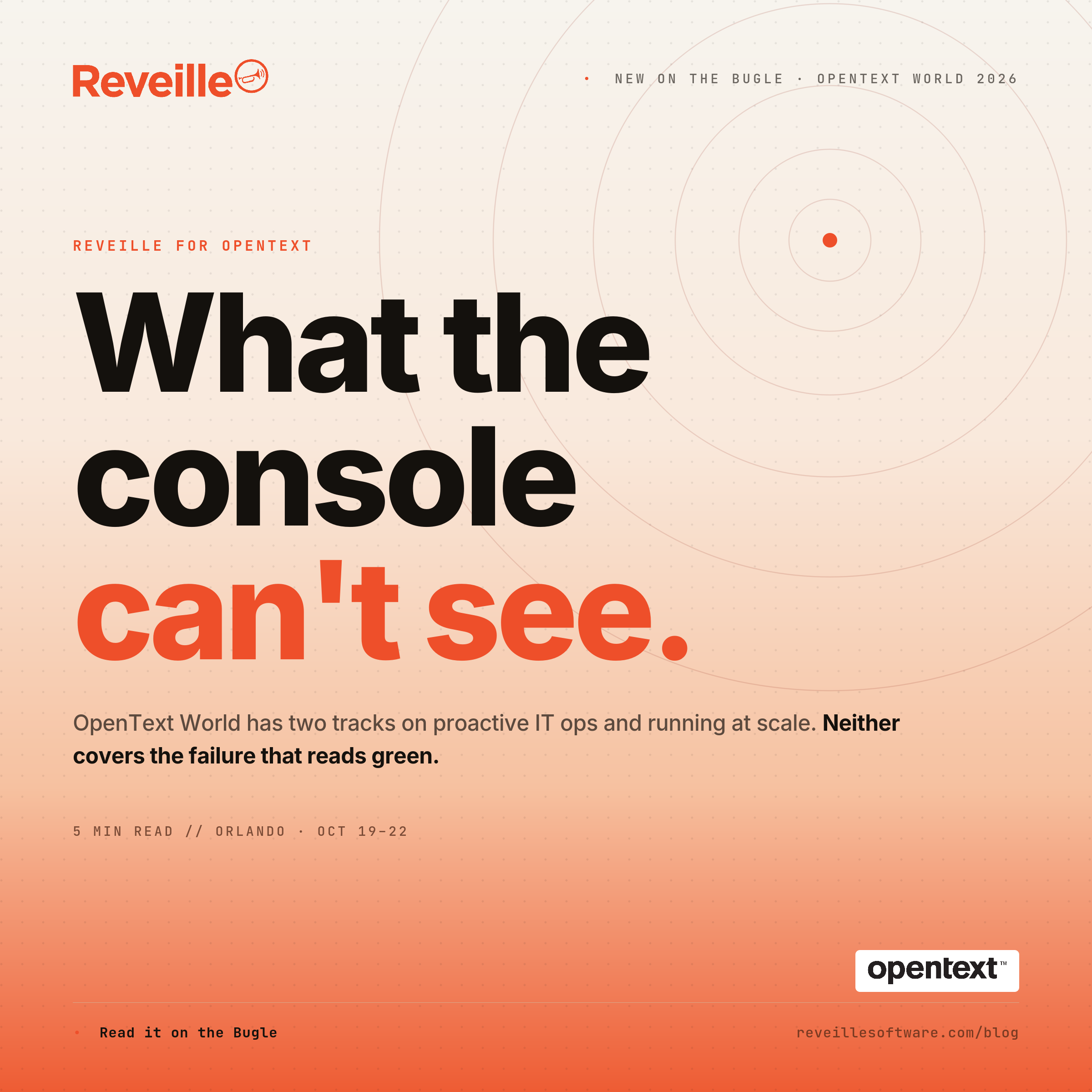

A green console is a statement the platform makes about itself. It is not a statement about your work.— The Reveille Perspective
OpenText World 2026 runs October 19–22 at the Hyatt Regency Orlando. Two of this year’s seven tracks are worth reading twice if you run Documentum, Content Management (Extended ECM), Capture, or Information Archive: “Transition to proactive IT operations” and “Running OpenText at scale: stability, performance, outcomes.” Those are the right problems. OpenText is putting them on the main agenda, and that matters.
The sessions in those tracks will be built on OpenText’s own consoles, dashboards, and services. That is what a vendor conference is for. But every one of those tools shares one limit: it reports on the platform from inside the platform. It can tell you a service is running. It cannot tell you that the work stopped two hours ago.
That space, between what the console reports and what the workflow is actually doing, is the console gap. It is the thing neither track will cover, and it is why Reveille is spending four days in Orlando.
Core Tension
Proactive IT operations means seeing the failure before the ticket. A console that only sees its own platform cannot see the failures that happen between platforms, in queues, or in work that is technically still “running.”
Quick answers
What is OpenText World 2026?
Will Reveille be at OpenText World 2026?
Why isn’t the OpenText admin console enough to catch workflow failures?
What does Reveille check on OpenText platforms?
01 — The Tracks
What OpenText put on the agenda, and what it leaves out
Proactive IT operations and running at scale are the right two tracks. They stop at the vendor’s boundary.
Read the two track descriptions and you get a clear picture of what OpenText thinks its customers are struggling with: stability under load, performance, and getting ahead of problems instead of reacting to them. That picture matches what Reveille hears from Documentum and Capture teams every week.
What the tracks will teach is how to do that with OpenText tooling: the admin consoles, the service health views, the platform logs. Those tools are good at what they cover. The gap is in what they do not cover. The Documentum Administrator sees the repository. It does not see the Content Transformation Services queue backing up to 400 tasks because one rendition profile is failing. The Capture Administrator sees the servers. It does not flag that eleven batches have been in hold status since 6:40 AM and nobody has released them.
Reveille publishes exactly what it tests on each platform. The full set for Documentum, more than 100 tests across Content Server, xPlore, CTS, OTDS, and the DFS services, is on the Reveille for OpenText Documentum technical overview. The point of that list is not the number. It is that most of the checks on it are conditions a console cannot raise on its own, because the console is the thing being checked.
02 — The Gap
Four ways an OpenText platform stays up while the work stops
One per platform. Each one reads green in the vendor console.
These are not outages. Outages get noticed. These are the conditions that cost a day of throughput before anyone opens a ticket, and they are the conditions Reveille’s OpenText test library was built around.
The index that fell behind
The xPlore index agent is running. It is also 90 minutes behind. Every document filed since mid-morning is in the repository and invisible to search. Users file tickets saying documents are “missing.” They are not missing. They are unindexed, and the console shows the agent as healthy.
The batches in hold
The Capture servers are up and the DAL is responding. Eleven batches have sat in hold status since the morning scan because a department queue was never serviced. Invoices in those batches will miss the payment run. Server health never changed.
The search slice that stopped
Content Server is up, OTDS is issuing tokens, users are logging in. One search slice has stopped reporting activity. Results come back partial and nobody knows which partition is missing. Search looks slow, not broken, so it waits until Monday.
The ingest errors nobody reads
The Information Archive services are green and xDB is healthy. The ingest error log has been growing since Tuesday. Records that were supposed to be under retention are not in the archive, and the first person to find out will be the auditor.
Each of these is a specific test in Reveille, not a general health score. When the condition trips, Reveille alerts the people who own the workflow, and for the common cases, such as a stalled index agent or a service that needs a restart, it runs the fix itself before a ticket exists. The record of what happened is written by Reveille, not by the platform that had the problem. That is the difference between vendor-native tools and Content Observability: one measures the platform from inside it, the other measures the work from outside it.
Principle
Platform SLA is not workflow SLA. OpenText measures the first. Someone has to measure the second, and it should not be the vendor.
03 — The Floor
Where Reveille will be at OpenText World 2026
Hyatt Regency Orlando, October 19–22. Jason Engen and Wayne Ford, all four days.
Reveille is walking the floor rather than standing at a booth. Jason Engen, Director of Sales and Partner Development, and Wayne Ford, CRO, will be at the Hyatt Regency Orlando from Monday through Thursday, including the OpenText World expo hours and the sessions in the two tracks above.
Bring the condition your console cannot explain. A Documentum search that returns nothing for new documents. A Capture process whose batch aging keeps creeping up. An Extended ECM estate where search time doubled and nothing in the admin view changed. Jason and Wayne will show you the specific Reveille test for it, on any of the four OpenText platforms Reveille covers, in about twenty minutes.
Reveille for OpenText
One observability layer across Documentum, Content Management (Extended ECM), Capture, and Information Archive. Cloud-native by design, deployment-agnostic by choice, and not built, sold, or operated by OpenText. If you read the Documentum search troubleshooting post and recognized your environment, that is the conversation to have in Orlando.
04 — The Point
Two ways to leave Orlando
Same sessions, same estate, different November.
In one version, the team comes home from the proactive IT operations track with a better alerting setup inside the OpenText console, and in November a Capture queue goes unserviced for a day. The console stays green the whole time, because the console was never going to see it.
In the other version, the team comes home with the same console improvements and an independent set of tests on the queues, the index agents, the search slices, and the ingest logs. The same Capture queue stalls. Reveille catches it at the second missed interval, releases it, and the only evidence is a line in the log.
The difference is not how good the OpenText tooling is. It is whether anyone is measuring the work from outside the platform that runs it.
Which version is your team bringing home?
Running Documentum, Extended ECM, Capture, or Information Archive?
Try Reveille on a sample OpenText estate before you get to Orlando, or find Jason and Wayne on the floor.
At OpenText World Oct 19–22? Email Jason with where you are and one of them will come to you.