
Everyone shipped the agent. Nobody shipped the assurance.— The Reveille Perspective
In the span of a single quarter, every major content platform put an autonomous agent on top of your documents. Hyland shipped its Enterprise Context Engine. Box took its Agent to general availability. Tungsten Automation previewed agents that run from documents to decisions to payment execution. OpenText turned its AI assistant on by default. The agentic enterprise stopped being a slide and became a setting.
Here’s the part nobody put on the keynote screen. Every one of those agents runs on content — and almost none of them shipped with an independent way to know whether that content can be trusted. The model is the easy part. The pipeline feeding it is where the failures live, and they fail quietly.
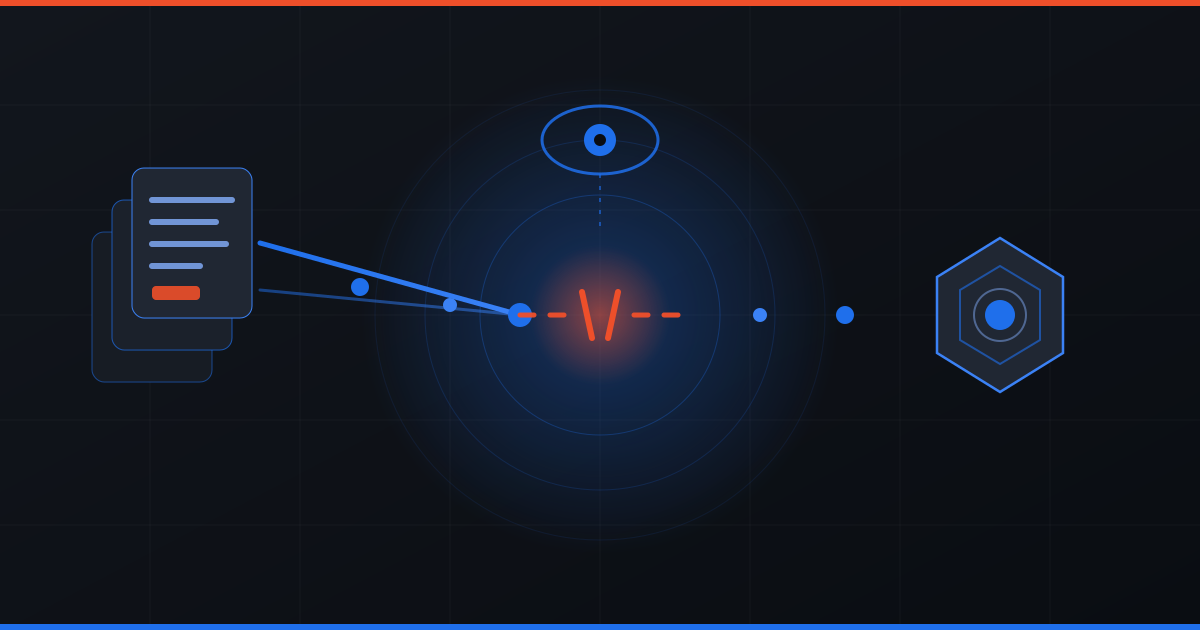
That distance — between an agent that’s deployed and content that’s actually trustworthy — is a new and expensive category of risk: the Assurance Gap.
Core Tension
67% of document-processing teams are deploying agentic AI. 57% admit their data isn’t ready for it. The agents are already acting on content no one is independently watching.
Quick answers
Why do agentic AI projects fail?
What is the Assurance Gap in agentic AI?
What does AI-ready data actually mean?
How does Content Observability help agentic AI?
01 — The Setup
The agent didn’t remove the risk. It hid it.
Autonomy doesn’t eliminate content failures — it removes the human who used to catch them.
Before agents, a person sat between bad content and a bad outcome. Someone eyeballed the invoice, noticed the OCR pulled the wrong total, and stopped the payment. That human checkpoint was slow, expensive, and inconsistent — and it was also the last line of defense.
Agentic Intelligent Document Processing (IDP) removes that checkpoint by design. When an agent reads a misclassified contract, routes it on a stale record, or commits an extraction that quietly dropped a field, there’s no pause, no second look. The agent does exactly what it was built to do: act, confidently, at machine speed. A wrong answer just became a wrong action — faster, and at far greater volume than a human would ever produce.
This is why “the platform is up” stopped being a useful sentence. A 99.99% availability number means the API responded. It says nothing about whether the content that flowed through it was right. Platform SLA is not workflow SLA — and an agent only knows the difference if something independent tells it.
02 — The Framework
Close the gap with Content Observability.
Continuous, independent verification of the content layer your agents run on.
Content Observability is the continuous visibility and assurance of the content and document workflows that drive business outcomes — and now feed AI. It’s the discipline of knowing, at the moment an agent reaches for a document, whether that document is current, complete, correctly extracted, and properly governed.
It is deliberately not the platform’s own dashboard. The vendor that sells the agent also grades its own homework — its monitoring stops at its own tenant boundary and reports against SLAs it authored. Reveille is the only observability layer not built, sold, or operated by the platforms it measures. It watches across Hyland, OpenText, Microsoft, IBM, Box, and Tungsten Automation from one place, and feeds the content-layer signal into the observability stack your team already runs.
Crucially, this is observability for AI — not AI replaced by it. You don’t make the pilot the air traffic controller. Agents need a content layer they can trust, and an external system that can tell when that trust is misplaced. That external system is the thing nobody shipped this quarter.
Forward Principle
An AI strategy without content assurance isn’t a strategy. It’s a faster way to be wrong.
03 — The Point
Two ways this plays out.
Same agents, same platforms — different outcomes.
In one version, the agents you deployed this year quietly compound value. They act on content that’s continuously verified, their mistakes get caught at the earliest signal, and when an auditor asks how you know the AI made the right call, you have an independent record that proves it.
In the other, the agents compound errors instead. A silent extraction failure becomes a wrong payment, a misrouted claim, a misclassified record that surfaces months later as a compliance event — and by then the damage is downstream and irreversible. You become part of the 60% of AI projects Gartner says get abandoned, not because the model was wrong, but because nobody could trust the data underneath it.
The difference isn’t the agent. It’s whether anyone was watching the content the agent runs on.
Your AI will act on your content either way. The only question is whether you’ll see the failure before it does.
Reveille Enterprise
1,000+ purpose-built tests assure the ECM, IDP, and automation workflows your agents depend on — detecting silent failures and self-healing across vendor boundaries, before an agent acts on bad content. See how Content Observability works →