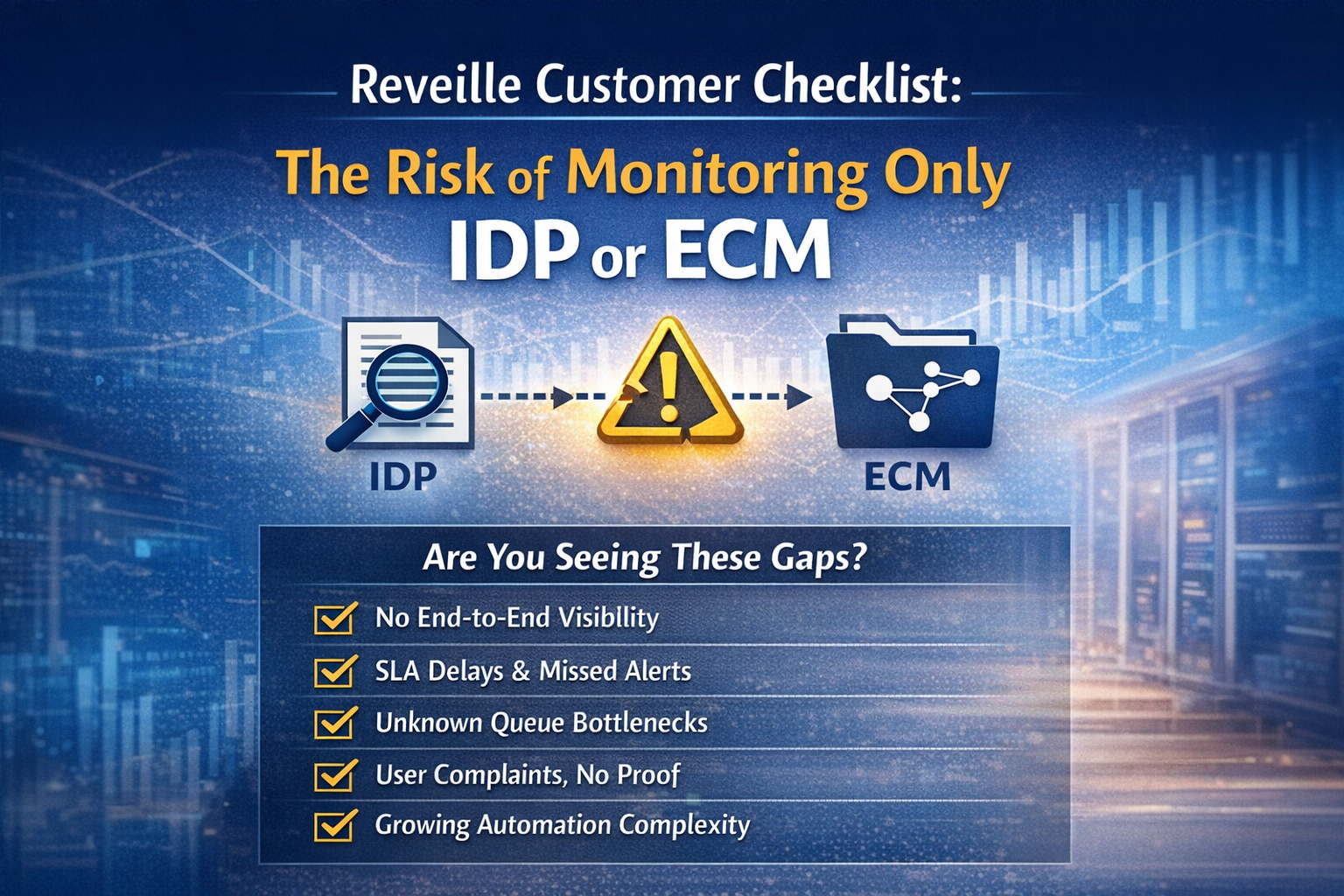

Start Here: Who This Checklist Is For
This checklist is written specifically for existing Reveille customers.
If any of the following apply, this is for you:
- You use Reveille to monitor an ECM platform (such as Hyland, OpenText, or IBM) but not for your upstream IDP platform.
- You use Reveille to monitor an IDP platform (such as ABBYY or Tungsten Automation) but not for ECM/workflow.
- You run both IDP and ECM, but observe them independently
In all three cases, you may have strong visibility into part of your document pipeline — while critical risk sits outside your current field of view.
Reveille Document & Content Process Assurance Checklist
Check all that apply. This is a self-assessment only—nothing is tracked or submitted. Score tallied at the end.
1. Coverage & Ownership
What this indicates: Observability is aligned to platforms, not the end-to-end process the business depends on.
2. Intake → Repository Handoff
What this indicates: Many issues don’t occur inside IDP or ECM—they happen at the handoff between them.
3. SLA & Business Impact
What this indicates: Platform health doesn’t always reflect business experience or SLA performance end to end.
4. User Experience & Proof
What this indicates: Without proof of user and transaction impact, teams are forced to infer what the business experienced.
5. Scale & Change
What this indicates: As complexity grows, partial observability becomes a systemic risk—small blind spots scale into major bottlenecks.
Checklist results: 0 of 0 items checkedHow to interpret your score:
0–4: Lower observed risk today (watch as volumes/complexity grow)
5–9: Moderate observability gaps likely affecting responsiveness
10+: High risk of silent failures between IDP and ECM impacting outcomesThis is a self-assessment only. No data is collected or submitted.
Why This Matters
Most document automation failures don’t show up as outages.
They show up as:
- Documents that arrive late
- Queues that quietly grow
- SLAs that drift before anyone notices
- Business teams feeling impact before IT sees alerts
When IDP feeds ECM, those platforms form one business-critical process. Monitoring only one side creates blind spots — especially at the handoff.
That’s the risk this checklist is designed to surface.Why These Gaps Are So Common
Most enterprises intentionally run best-of-breed stacks, for example:
- ABBYY or Tungsten handling capture and extraction
- Hyland, OpenText, or IBM managing repositories, workflows, and governance
Common real-world pairings include:
- ABBYY → IBM FileNet
- Tungsten Capture → OpenText Content Server
- FlexiCapture → Hyland OnBase
Each platform may be healthy on its own — but the business only experiences the end-to-end flow.
Monitoring tends to stop at vendor boundaries.
Processes do not.
What End-to-End Observability Actually Means
For Reveille customers, end-to-end observability across IDP and ECM means visibility into:
- Document intake and extraction performance
- Processing latency and queue behavior
- Handoff health between platforms
- Downstream workflow throughput
- Real user and business impact
This isn’t about replacing what you already have.
It’s about extending observability to the parts of the pipeline you don’t see today.
The Takeaway
If you’re using Reveille for only part of your document pipeline, you may be leaving risk unobserved.
Monitoring only IDP or ECM is not wrong — it’s just incomplete.
When IDP feeds ECM, observability has to span both.
Schedule a call with us to discuss our ECM+IDP packaging options.